

What is Google Voice Search?
Google voice search explained: how it works, how spoken queries differ from typed ones and how to optimise your site and local listing for voice.
Feb 9, 2026 • 6 min read
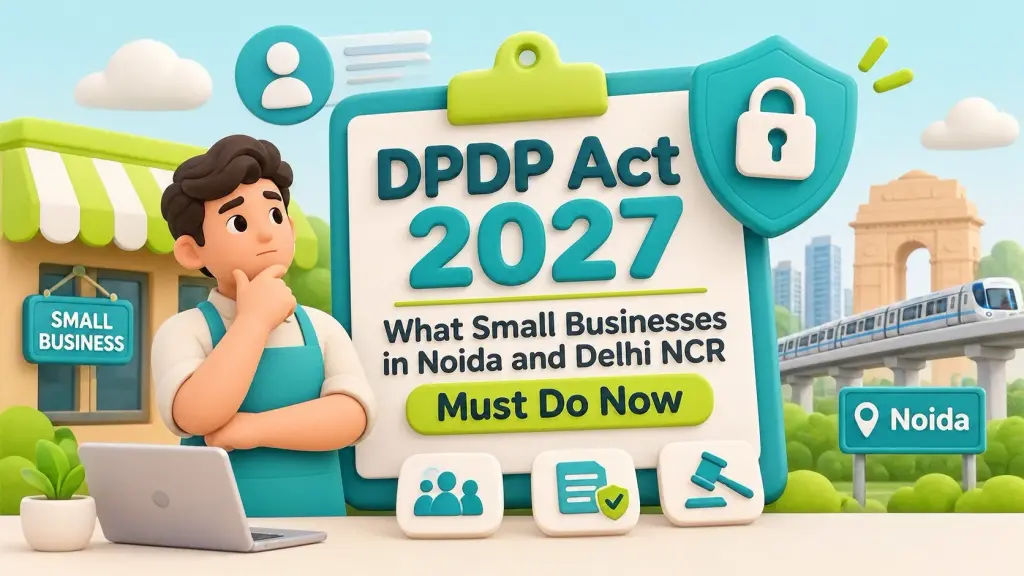
The DPDP Act 2027 is becoming a practical business priority for companies across Noida, Gurugram, Delhi, and the wider National Capital Region. Whether you run a clinic, coaching institute, retail store, real-estate firm, restaurant, or digital agency, you likely collect names, phone numbers, email addresses, and other customer details every day.
With the DPDP Rules, 2025 introducing an 18-month phased compliance period, businesses in Noida and Delhi NCR should begin preparing now for the principal privacy, security, and breach-notification obligations scheduled to take effect from 13 May 2027.
India’s Digital Personal Data Protection Act, 2023 sets rules for how organisations collect, use, store, and protect personal data. The Government has also notified the DPDP Rules, 2025, which operationalise the Act and require organisations to provide clear consent notices and maintain contact and grievance channels.
For a small business, compliance does not need to be complicated. Start with a clear understanding of the data you hold, obtain proper consent, protect customer information, and create a simple process for privacy requests.
The DPDP Act is India’s low for protecting digital personal data. It gives individuals greater control over their information and places responsibilities on organisations that decide why and how that data is processed.
Under the Act:
A small business in Noida may qualify as a Data Fiduciary even if it has only a few employees. For example, if a boutique collects phone numbers for order updates or a coaching centre stores student contact details for admission follow-ups, it is handling personal data.
The Digital Personal Data Protection (DPDP) Act is expected to be fully and strictly enforceable from 13 May 2027. The Government of India notified the DPDP Rules, 2025 in November 2025 and provided businesses with an 18-month phased compliance period.
This timeline gives small businesses in Noida, Delhi, Gurugram, and the wider Delhi NCR region time to review their systems, update consent processes, train staff, and strengthen data-security practices.
The first phase has already begun. It covers the initial rules connected with the establishment and administration of the Data Protection Board of India.
During this phase, businesses should begin assessing the personal data they collect, where it is stored, who can access it, and which vendors process it on their behalf.
The second phase focuses on the registration and functioning of Consent Managers. These are entities that help individuals manage their permissions and consent preferences across participating businesses.
Stop guessing. Start growing. Find out exactly what is holding your website back from ranking on Google in seconds.
For small businesses, this phase is a good time to review website forms, lead-generation campaigns, WhatsApp marketing, email lists, CRM systems, and third-party marketing tools.
From 13 May 2027, the core DPDP obligations will apply more strictly. Businesses will need to follow stronger requirements for customer consent, data security, breach response, and grievance redressal.
Key obligations include:
Non-compliance can lead to significant penalties. Under the DPDP framework, failure to maintain reasonable security safeguards can attract a penalty of up to ₹250 crore, while failure to meet breach-notification obligations can attract a penalty of up to ₹200 crore.ksandk+1
For a small business, the message is clear: do not wait until May 2027. Start preparing now by creating a data inventory, reviewing consent notices, securing customer data, and setting up a simple breach-response process.
Delhi NCR has a large number of service businesses that depend on digital enquiries. Customers discover businesses through Google, social media, WhatsApp, and local listings. They often share contact details through website forms, landing pages, lead ads, and WhatsApp Business.
That convenience creates responsibility. If your business collects a lead’s phone number, it should be clear why you collected it, how you will use it, who can access it, and how the customer can ask questions or withdraw consent.
The DPDP Rules require Data Fiduciaries to issue a separate consent notice in clear, easy-to-understand language. The notice must explain the specific purpose for collecting and using personal data.
For Noida businesses, this is also a customer-trust issue. People are more likely to share accurate details when they understand how a business will use them.
Before changing your website or privacy policy, identify what customer data your business already holds.
Create a simple spreadsheet with these columns:
| Data type | Where it is stored | Why it is collected | Who can access it | Retention period |
| Name and phone number | CRM or Google Sheets | Enquiry follow-up | Sales team | Define a period |
| Email address | Email marketing tool | Newsletters and offers | Marketing team | Define a period |
| Payment details | Payment gateway | Order processing | Accounts team | Follow legal and business needs |
| Customer support chats | WhatsApp or helpdesk tool | Service support | Support team | Define a period |
Do not collect data simply because it may be useful later. Under DPDP, consent should be limited to the personal data necessary for the stated purpose.
For example, a gym in Noida may need a member’s name, phone number, and emergency contact for membership and safety. It does not necessarily need detailed health information unless the member voluntarily provides it for a specific service.
Get certified by industry experts. Join our comprehensive 360° training program and land your dream job with practical, hands-on experience.
Explore Courses
A consent notice should be easy for a normal customer to understand. Avoid long legal language, hidden checkboxes, or broad claims such as “we may use your data for marketing.”
A good notice explains:
Here is a simple example for a website enquiry form:
“We collect your name, email address, and phone number to respond to your enquiry and provide relevant service information. We do not sell your data. You can contact [email address] to withdraw consent or ask a question about your data.”
For marketing messages, make consent separate and specific. A customer who submits an enquiry should not automatically be added to a WhatsApp broadcast list or email newsletter unless they clearly agreed to receive marketing communication.
The DPDP framework reinforces the rights of individuals over their personal data. Businesses should be prepared to respond when a customer asks to access, correct, update, or erase their information.
Your business should make it easy for customers to:
Create a basic workflow for your team:
A small business does not need expensive software to begin. A shared request tracker, a designated privacy contact, and clear staff instructions can make a major difference.
The DPDP Rules require businesses to provide a point of contact for questions about personal data and maintain a grievance-redressal process.
Add a clear section to your website titled Privacy Contact or Data Protection Grievance. Include:
This is especially important for businesses that handle sensitive customer information, such as healthcare providers, educational institutions, financial-service firms, and real-estate companies.
A privacy policy alone does not protect customer data. Small businesses should use practical security controls.
Scale your business with high-performance, IOS and Mobile Apps.
Start Your Project
Start with these steps:
If you work with external agencies, freelancers, or software vendors, review their data practices. Ask what data they receive, where it is stored, how long they retain it, and what happens if there is a security incident.
A data breach can happen through a hacked email account, a compromised website plugin, an exposed spreadsheet, or a lost device. The DPDP framework requires affected individuals and the Data Protection Board to be notified promptly in the event of a breach.
Every small business should have a simple incident plan:
Preparation matters. A business that can respond quickly and communicate clearly is better placed to protect customers and maintain trust.
Small businesses in Noida and Delhi NCR can begin with these actions:
DPDP compliance is not a one-time website update. It is an ongoing process of collecting only necessary data, explaining its use clearly, protecting it properly, and respecting customer rights. Businesses that build these habits early will be better prepared for 2027.
This article is for general information only and does not constitute legal advice. For guidance specific to your business, consult a qualified data-protection or legal professional.
Government notifies DPDP Rules to empower citizens and protect privacy — Press Information Bureau, Government of India.
DPDP Rules, 2025 Notified — Press Information Bureau, Government of India.
The Digital Personal Data Protection Act, 2023 — Ministry of Electronics and Information Technology, Government of India.
The Digital Personal Data Protection Act, 2023 — India Code, National Informatics Centre.
Google voice search explained: how it works, how spoken queries differ from typed ones and how to optimise your site and local listing for voice.

SEO pricing in India explained: what affects monthly SEO costs, what each plan should include and how our plans compare. Choose with confidence.
AI personalization for websites: how dynamic content, segmentation and chatbots improve customer experience, with a step-by-step plan to start.

A digital marketing workshop for entrepreneurs: 10 benefits like more visibility, better sales and faster growth. See what you learn and who should join.