

What Is SEO Pricing? Are Monthly SEO Services a Better Idea?
What is SEO pricing and are monthly SEO services a better idea? See how SEO is priced, what packages include and how to reduce the cost without losing results.
Feb 5, 2026 • 6 min read
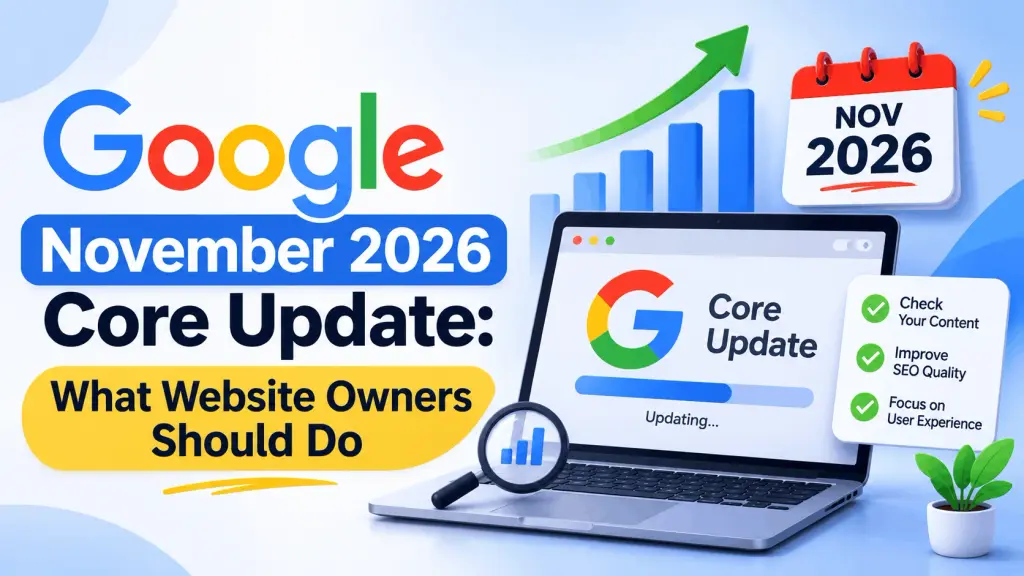
Google has started rolling out the Google November 2026 Core Update. The update began on 10 November 2026 and may take up to two weeks to complete. It applies to search results worldwide and across all languages.
If your website traffic or rankings have changed, do not panic. A core update does not target one website or one type of content. Instead, Google reviews the overall quality and relevance of pages across Search.
For business owners, bloggers, and digital marketing agencies, this is the right time to review content, improve user experience, and focus on long-term SEO.
The Google November 2026 Core Update is a broad ranking update. It changes how Google evaluates web pages in Search results.
Google releases core updates several times a year. These updates help Google show more relevant and helpful results to users.
A core update is different from a spam update. It does not target a specific website, niche, or industry. Therefore, a ranking drop does not always mean that your website has been penalized.
Google wants Search results to remain useful. Websites publish new content every day. At the same time, older pages may become outdated.
Because of this, Google needs to reassess pages from time to time. Core updates help Google compare content and decide which pages best match a user’s search intent.
For example, a blog post may rank well today. Later, another website may publish a clearer, more detailed, or more updated guide. After a core update, Google may move the better page higher in Search results.
Google confirmed that the November 2026 Core Update started on 10 November 2026 at 10:06 AM Pacific Time.
The rollout is global. It affects websites in all languages and regions. Google also says the rollout may take up to two weeks to finish.
During this period, rankings may move up and down. Therefore, website owners should not judge their SEO performance too early.
Google may release the update gradually across different data centers. As a result, some users may see different rankings at different times.
This can create confusion for website owners. One day, traffic may fall. The next day, it may rise again.
Therefore, wait until the rollout is complete before making major SEO decisions. Google also advises waiting before comparing performance in Google Search Console.
Core updates can affect rankings in many ways. Some pages may gain visibility. Others may lose rankings.
However, this does not always mean that a page has become bad. Sometimes, another page simply becomes a better match for the search query.
Google compares pages against each other. It looks at relevance, helpfulness, expertise, and user experience.
A page may lose rankings after a core update because of one or more reasons:
The content does not fully answer the search query.
Another website offers a more complete answer.
Information is outdated.
Page lacks clear expertise or trust signals.
Content is difficult to read.
Pages does not match user intent.
Website has weak internal linking.
The page experience is poor on mobile devices.
Stop guessing. Start growing. Find out exactly what is holding your website back from ranking on Google in seconds.
These issues do not always cause a ranking drop. However, improving them can make a website stronger over time.
The first step is to stay calm. Do not delete pages or rewrite your entire website during the rollout.
Google recommends waiting until the update is complete. After that, review your website performance carefully.
Google Search Console is the best tool for reviewing ranking changes. It shows impressions, clicks, average position, and click-through rate.
Check the performance of your important pages. Also, review the queries that bring traffic to your website.
However, do not compare only one or two days of data. Wait at least a week after the rollout ends. Then, compare the post-update period with a similar period before the update.
Do not look only at total website traffic. A core update may affect only one part of your website.
Review these page types:
Blog posts
Service pages
Product pages
Landing pages
Category pages
Location pages
FAQ pages
Author pages
Find pages that lost traffic, impressions, or rankings. Also, check which pages improved. This will help you understand what needs attention.
Content quality is one of the most important factors during a core update. Google wants websites to create helpful, reliable, and people-first content.
Therefore, review your most important pages one by one.
For every important page, ask:
Does the page answer the user’s question?
Is the information accurate?
Is the content original?
Does the page show real experience or expertise?
Is the content easy to read?
Is the page updated with current information?
Does the page provide more value than competing pages?
If the answer is no, improve the page. Add useful examples, clear headings, updated facts, and better explanations.
Get certified by industry experts. Join our comprehensive 360° training program and land your dream job with practical, hands-on experience.
Explore Courses
Thin content does not help users. It may repeat the same information without adding value.
Instead, create content that solves a real problem. Use clear language. Add practical steps, examples, and relevant information.
For a digital marketing agency, this may include SEO guides, case studies, marketing tips, and industry updates. The goal is to help users, not only to rank in Google.
Search intent means the reason behind a user’s search. A page must match that reason.
For example, someone searching for “Google November 2026 Core Update” may want to know:
What the update is
When it started
How it affects rankings
What actions to take
How long the rollout will take
Therefore, your content should answer these questions clearly.
Before writing or updating a page, understand what users want.
Some users want information. Others want to compare options. Some want to buy a service. Others want a quick answer.
Create content that matches the intent. This makes the page more useful and improves its chance of ranking well.
Content is important, but user experience also matters. Google wants users to have a good experience on websites.
Check these areas:
Page speed
Mobile usability
Clear navigation
Readable fonts
Helpful internal links
Easy-to-find contact information
Clear headings and structure
Secure website connection
A good page experience helps users stay longer and find what they need. It also supports better SEO performance.
Internal links help users move from one page to another. They also help Google understand your website structure.
Use internal links naturally. Link related pages with clear anchor text. For example, link a blog post about SEO to a relevant service page.
However, do not add too many links. Every link should make sense for the reader.
Scale your business with high-performance, IOS and Mobile Apps.
Start Your Project
Many website owners make mistakes after a core update. These mistakes can hurt long-term performance.
Do not rewrite every page or delete content immediately. Google advises against quick fixes and recommends focusing on meaningful improvements.
Instead, wait for the update to finish. Then, review the data and make planned changes.
SEO is not about finding shortcuts. Keyword stuffing, low-quality content, and spammy links do not build a strong website.
Focus on real value. Create content that helps users. Build trust through experience, expertise, and useful information.
Sometimes, a small page can affect the overall quality of a website. Review old blog posts, thin service pages, and outdated landing pages.
Improve them if possible. If a page cannot be improved, Google says removing it may be an option. However, deletion should be a last resort.
For a digital marketing agency, a core update is a chance to support clients with a clear plan.
At GrowthWonders, we recommend a calm and practical approach. First, monitor the data. Then, improve pages that need better content, structure, or user experience.
A strong agency response includes:
Reviewing Google Search Console after the rollout
Identifying pages with major traffic changes
Checking content quality and search intent
Updating outdated information
Improving internal links and site structure
Creating useful content for real users
Avoiding panic-driven SEO changes
There is no fixed recovery time. Some websites may see changes within days. Others may need several months.
Google explains that improvements may take time because Google reassesses the overall quality of a website. In some cases, website owners may need to wait until the next core update to see a clear improvement.
Therefore, focus on steady progress. Improve content, build authority, and keep helping users.
The Google November 2026 Core Update is a broad change to Google Search. It started on 10 November and may take up to two weeks to complete.
Website owners should avoid panic. Instead, they should review Google Search Console, identify affected pages, and improve content quality.
The best SEO strategy is simple: create helpful content, match search intent, improve user experience, and keep learning. Websites that focus on real value are more likely to perform well over time.
References:
Search Central – Google Search’s Core Updates and Your Website
Google Search Status Dashboard – November 2026 Core Update
Google Search Central – Latest Google Search Documentation Updates
Interested in this? See our SEO company in Noida page, or talk to us directly.
Explore SEO What is SEO pricing and are monthly SEO services a better idea? See how SEO is priced, what packages include and how to reduce the cost without losing results.

Boost engagement with AI-powered personalization. Learn how to create dynamic content and personalised customer experiences that lift conversions and loyalty.

Learn how AI-powered digital marketing helps entrepreneurs save costs, manage teams and master AI tools to grow their business in Noida and beyond in 2026.

How Social Media Brand Awareness : build a strong presence with consistent content and community, and see why it takes steady time and effort.