

My Proven Strategy: LinkedIn Marketing for Business Growth
Unlock B2B LinkedIn Marketing. Discover the common mistakes Noida businesses make and how to use employee advocacy, video, and AI tools to win in 2026.
Jan 16, 2026 • 12 min read
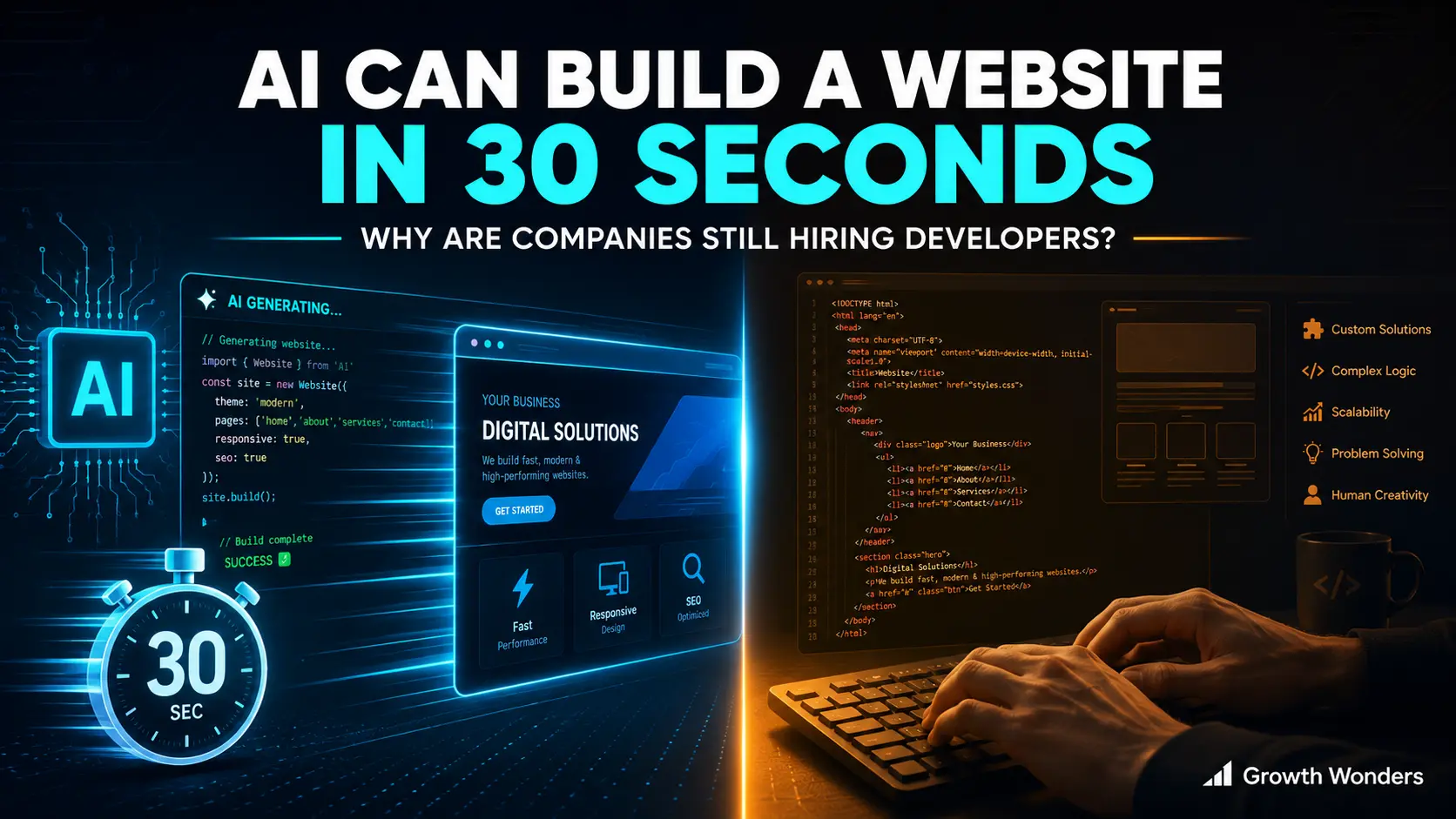
While artificial intelligence can generate boilerplate website code in mere seconds, the demand for human software developers remains remarkably robust. This research explores the contrarian reality of AI in software engineering, analyzing 2025 and 2026 empirical data to demonstrate that coding syn tax represents only a fraction of web development. While AI accelerates code generation, it struggles with resolving complex business logic, managing technical debt, securing applications, and navigating stakeholder requirements. Consequently, companies recognize that true digital transformation requires experienced human oversight, architectural product thinking, and strategic, customized web development to translate business objectives into scalable, secure ecosystems.
The digital landscape has long been captivated by the promise of frictionless creation. Long before AI entered the mainstream, platforms like WordPress and Wix offered robust templates that made simple page creation accessible. Yet, enterprises and ambitious startups consistently opted to invest heavily in professional software developers. The core rationale remains unchanged: the true value of software engineering is not in generating digital pages, but in determining what needs to be built, how it integrates into operational workflows, and how it scales securely over time.
Today, advanced AI-powered tools like v0, Bolt, and Lovable can rapidly prototype user interfaces and generate full-stack boilerplate in seconds. This has led to narratives suggesting the imminent obsolescence of the human developer. However, empirical data from 2025 and 2026 reveals a profoundly different reality. AI is an exceptional amplifier of speed, but speed without direction and structural integrity often results in systemic fragility.
This article examines why companies are actively retaining and quietly rehiring software engineers despite the proliferation of AI code generation.
To understand AI's limitations, we must first acknowledge its staggering capabilities. By early 2026, 84% of developers reported using or planning to use AI tools, with 51% utilizing them daily. The market expansion underscores this perceived value: GitHub Copilot reached approximately 20 million users by mid-2025, and AI coding environment Cursor surpassed $2 billion in ARR by early 2026.
Research indicates these tools provide a substantial productivity lift for isolated tasks. Software developers initially reported completing specific coding tasks up to 55% faster with generative AI. The process is categorized into four levels:
However, this acceleration isn't uniform. Junior developers lacking foundational knowledge sometimes take 7 to 10 percent longer to complete tasks with AI, struggling to verify the output. Furthermore, while large language models (LLMs) possess vast syntax knowledge, they are fundamentally passive; they do not independently drive complex workflows involving multiple decision points without continuous human prompting. AI is an exceptional coding assistant, but it is not an autonomous engineer.
Stop guessing. Start growing. Find out exactly what is holding your website back from ranking on Google in seconds.
The primary fallacy in the automated web development narrative is conflating the generation of a web interface with solving a multifaceted business problem. An enterprise website is a complex, stateful application interfacing with legacy databases, third-party APIs, and highly specific organizational rules. When questioning how AI website builders work v0 bolt new lovable limitations, the answer lies in their boundary of context. They generate components but don't understand the enterprise ecosystem.
Nearly eight in ten companies report using generative AI, yet an equal number report no significant bottom-line impact—the "gen AI paradox." AI models excel at translating intent into syntax, but they cannot infer business intent.
Nearly eight in ten companies report using generative AI, yet an equal number report no significant bottom-line impact—the "gen AI paradox." AI models excel at translating intent into syntax, but they cannot infer business intent. To produce viable output, AI agents require profound contextual scaffolding: domain knowledge, architecture diagrams, API contracts, and nonfunctional expectations. Good AI output is the result of meticulously curated context, not merely clever prompting.
Coding is the mechanical act of writing instructions; software engineering is the rigorous discipline of designing systems that solve human problems reliably.
Coding is the mechanical act of writing instructions; software engineering is the rigorous discipline of designing systems that solve human problems reliably. It falls entirely upon the human software developer to act as the conduit between abstract business requirements and the strict logic required by the machine.
As AI shifts from controlled experiments to enterprise-wide integration, longitudinal data reveals severe challenges. The initial 55% speed boosts have normalized to a more modest 26% in practical applications. Rapid injection of machine-generated code into production has catalyzed an escalating technical debt crisis and created a "trust paradox" among professionals.
Technical debt is spiraling in the AI era. A massive 2026 empirical study analyzed 304,362 verified AI-authored commits across 6,275 GitHub repositories. Researchers identified 484,606 distinct issues introduced by AI, with "code smells"—indicators of deeper architectural flaws—accounting for 89.1% of instances. Alarmingly, 24.2% of the issues introduced by AI survived through to the latest repository revisions, translating into compounding maintenance costs.
Get certified by industry experts. Join our comprehensive 360° training program and land your dream job with practical, hands-on experience.
Explore Courses
Industry analytics reflect this debt. Projects heavily using AI show a 60% decline in refactored code and a four-fold increase in code duplication, alongside a near-doubling of code churn (code rewritten within two weeks). AI lowers the friction of code generation, allowing developers to copy vast blocks of logic rather than designing reusable functions, resulting in brittle codebases.
| Metric | Result |
|---|---|
| Total AI-authored commits analyzed | 304,362 |
| Distinct issues introduced | 484,606 |
| Code smells (architectural flaws) | 89.1% |
| AI issues surviving to latest revision | 24.2% |
| Refactored code decline | 60% decline |
| Code duplication increase | 4x increase |
The 2025 DevOps Research and Assessment (DORA) report reveals that while AI adoption improves deployment throughput and lead times by 2-18%, it correlates with a drop in software stability. For every 25% increase in AI adoption without proper architectural guardrails, organizations experience a 1.5% drop in throughput due to accumulating bugs. DORA metrics measure how fast code ships, not value delivered. In AI-native teams, coding time has collapsed, but review time has expanded significantly.
Despite 84% of developers using AI in 2026, only 29% actually trust the output to be accurate—a decline from 40% in 2024. Over 66% of developers cite their greatest frustration as AI output that is "almost right, but not quite." Identifying subtle logical flaws in a dense block of AI-generated text is often more cognitively taxing than writing the code from scratch.
Technology projects rarely fail purely due to bad code; they fail due to misaligned expectations and shifting requirements. Stakeholders present conflicting priorities and moving deadlines. An AI website builder cannot read the nuanced hesitations of a client during a sprint review, nor can it tactfully push back against a feature that compromises core web vitals. Human developers remain essential mediators who align technical implementation with business reality.
To unlock AI's massive potential, organizations must rethink their models. The role of the developer is transitioning from raw code author to an "editor-in-chief" or systems architect. This requires immense product thinking. Humans must constantly review algorithmic updates, catch architectural drift, and ensure the AI's output authentically matches the business intent.
The automation of code generation introduces security vulnerabilities at machine speed. Analysis of 7,703 GitHub files explicitly attributed to major AI tools revealed:

Scale your business with high-performance, IOS and Mobile Apps.
Start Your Project
AI frequently replicates insecure patterns found in its training data, such as flawed tutorial code. To counter these systemic threats, platforms like Snyk have introduced "Secure at Inception" protocols via the Model Context Protocol (MCP), embedding security scanning directly into the AI coding assistant's loop. However, utilizing these guardrails still requires sophisticated human oversight to configure thresholds and orchestrate remediation.
The software engineering industry is entering a phase of deep recalibration. Gartner predicts that by 2028, engineering teams applying AI securely across the development life cycle will achieve sustainable 25–30% productivity gains. Simultaneously, a distinct trend of "quiet rehiring" has emerged. Companies that reduced engineering headcount in anticipation of AI automation are actively recruiting senior software developers. The industry recognizes the critical importance of maintaining institutional knowledge and the architectural foresight required to manage AI-generated code at scale.
While AI can generate interface syntax rapidly, engineering a digital platform that authentically serves enterprise goals requires a structured approach. Relying on automated builders often results in a labyrinth of technical debt, compromised security, and a misalignment with core business objectives. For businesses seeking a high-performing digital footprint, professional intervention is a strategic imperative.
Growth Wonders stands at the vanguard of this engineering reality. Understanding how overwhelming a digital transformation can feel, Growth Wonders offers comprehensive website development services that bring structured clarity to enterprise chaos. Moving far beyond automated code generation, the agency leverages a six-stage methodology to align user needs with strict business demands.
Through custom web development, Growth Wonders engineers scalable digital ecosystems using modern frameworks like Astro 5.0, React, and custom Node.js environments. This meticulous approach guarantees zero code bloat, lightning-fast sub-second average page load times, and flawless Core Web Vitals scores. By adhering to precise 8px grid UI designs and utilizing Tailwind CSS styling, they ensure platforms are structurally optimized to capture user attention and convert leads.
Providing a full-stack digital ecosystem from their Noida Sector 63 headquarters, Growth Wonders seamlessly integrates technical SEO optimization, comprehensive PPC campaigns, and custom CMS builds. By utilizing dedicated server configurations and deploying strict local SEO strategies, they ensure businesses dominate their regional search areas. Partner with Growth Wonders to deploy secure, purpose-driven digital foundations built to perform and evolve safely over time.
While artificial intelligence can generate boilerplate website code in mere seconds, the demand for human software developers remains remarkably robust. This research explores the contrarian reality of AI in software engineering, analyzing 2025 and 2026 empirical data to demonstrate that coding syn tax represents only a fraction of web development. While AI accelerates code generation, it struggles with resolving complex business logic, managing technical debt, securing applications, and navigating stakeholder requirements. Consequently, companies recognize that true digital transformation requires experienced human oversight, architectural product thinking, and strategic, customized web development to translate business objectives into scalable, secure ecosystems.
Unlock B2B LinkedIn Marketing. Discover the common mistakes Noida businesses make and how to use employee advocacy, video, and AI tools to win in 2026.
Don't let mistakes ruin your projects Learn about the top 6 common mistakes made in Web Development Projects and how to avoid them.

Web Development Company in Noida help the new and old institutes in building the interests of people towards them.
Therefore, it's recommended to check with your registrar or review the terms and conditions of your Domain Renew