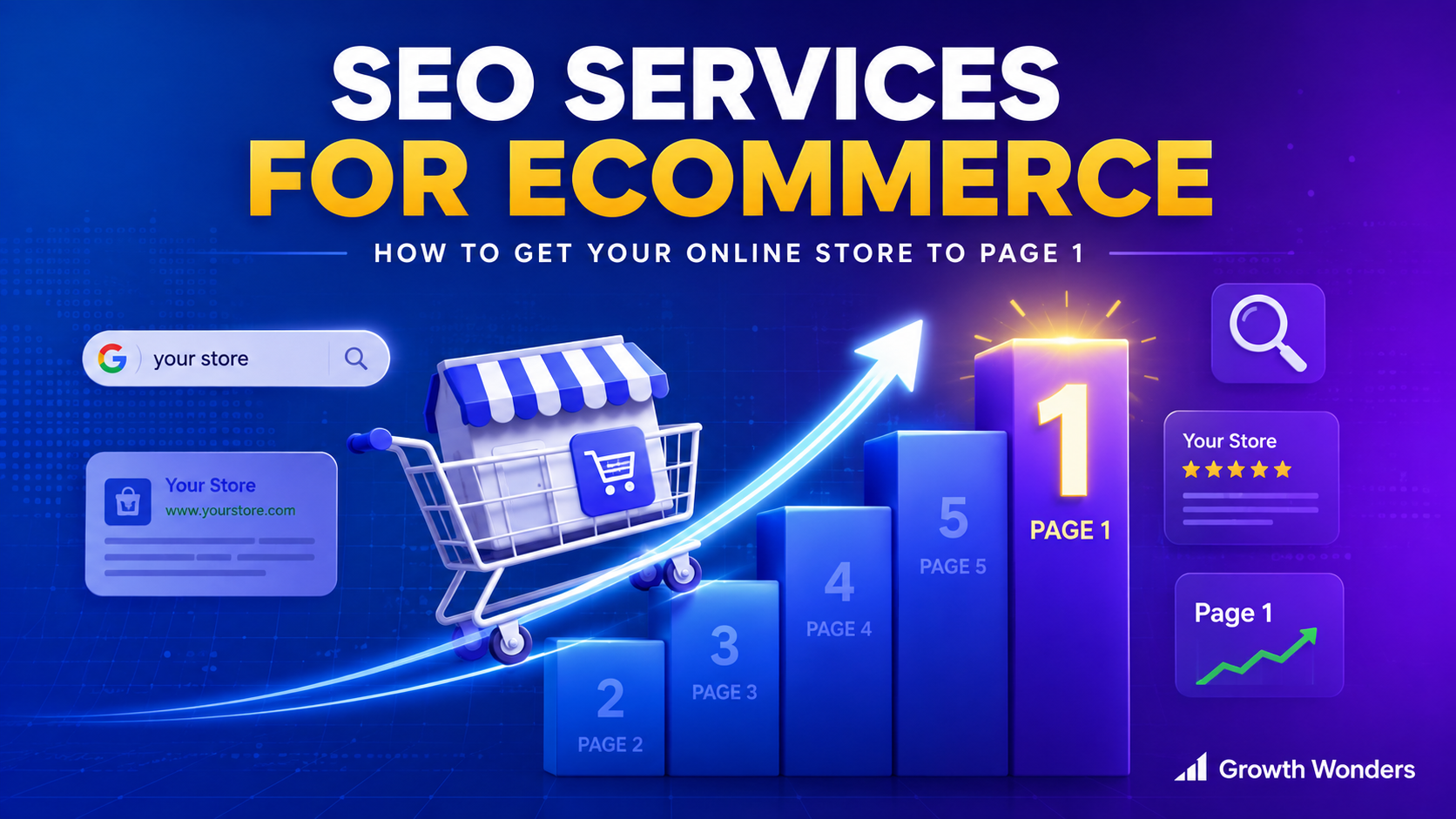
SEO Services for Ecommerce: How to Get Your Online Store to Page 1
Aug 5, 2026 • 10 Min Read
Share
Why Your Ecommerce Store Is Invisible on Google And How SEO Fixes It
Let’s be honest. If you are running an ecommerce store in India right now, you know exactly what I am talking about when I say the "Meta Ads treadmill." You pour lakhs of rupees into Facebook, Instagram, and Google Ads every single month. Your dashboards look busy. Traffic flows in, you make some sales, and your revenue numbers climb.
But then, an experiment happens. Maybe you pause your campaigns for a weekend. Maybe your ad account gets temporarily suspended. What happens next is terrifying: the traffic vanishes instantly. The sales flatline.
You quickly realize that you don't actually own your audience. You are just renting it from Mark Zuckerberg and Sundar Pichai. And the rent is going up. Over the last three years, the Customer Acquisition Cost (CAC) for Indian D2C brands on Meta has skyrocketed by 40% to 60%. What used to cost you ₹800 to acquire a customer in 2023 is now easily touching ₹2,000 to ₹2,500 in 2025. This is a game of diminishing returns, and it's eating into your EBITDA margins.
So, how do you get off this treadmill? How do you build a sustainable stream of buyers that doesn't disappear the second you turn off the tap?
The answer is organic search. More specifically, tailored SEO services for ecommerce. Unlike ads, ranking on the first page of Google is an asset you own. When you rank #1 to #3 for a high-intent keyword, that page can deliver ready-to-buy customers for 18 to 36 months with minimal maintenance. It is the only compounding traffic channel left in the modern digital marketing playbook.
Consider this blog your roadmap out of the paid ads trap. I am going to walk you through exactly how ecommerce SEO services in India can transform your online store from an invisible catalog into a traffic-generating machine.
What is Ecommerce SEO and Why It's Different
A lot of founders I speak with confuse ecommerce search engine optimization with regular blogging SEO. They think, "I just need to write a few blog posts and my store will rank."
That is fundamentally incorrect. If you want to know how to rank your ecommerce website on Google, you need to understand that ecommerce SEO is infinitely more complex because it has to map directly to the buyer's full funnel.
Free Tool
Get Your Free SEO Audit
Stop guessing. Start growing. Find out exactly what is holding your website back from ranking on Google in seconds.
Let me break down the four types of search intent your store needs to capture:
Informational Intent: These are the top-of-funnel searches. For example, "what is the best material for running shoes" or "how to choose a mattress." The buyer is just researching.
Navigational Intent: They know what they want and they know the brand. E.g., "Nike Air Max mens."
Commercial Intent: They are narrowing down their options. E.g., "Best wireless earbuds under ₹3000."
Transactional Intent: The holy grail. They have their credit card in hand. E.g., "Buy Apple AirPods Pro online India."
Why is SEO important for ecommerce? Because most store owners only optimize for one stage (usually transactional, by just listing the product) and completely miss the other three. This means you are losing 75% of your potential customers to competitors who are educating them during the research phase.
Effective ecommerce SEO matches the exact intent of the searcher to the right page on your sitewhether that is a deeply informative blog post, a categorized product grid, or a highly optimized single product page.
The 4 Pillars of Ecommerce SEO
If you are serious about your ecommerce SEO strategy in 2025, you need to build your foundation on four distinct pillars. This is the heavy lifting that earns you backlinks, social shares, and most importantly, Google's trust. Let’s dive into them.
1. Product Page SEO
Your product page is your digital salesman. It has one job: convert traffic into cash. But to do that, Google needs to understand exactly what you are selling.
Title Tags: Keep them under 60 characters. A winning formula is: Product Name + Key Attribute + Brand + Year.
Meta Descriptions: These won't directly impact rankings, but they are your CTR (Click-Through Rate) hook. Write them to make the user want to click.
Product Descriptions: Forget the manufacturer's copy. You need 150-300 words of unique, benefit-driven copy.
Image Optimization: Search engines can't "see" images. Use descriptive alt text sprinkled with keywords to tell Google what the image is.
Trust Signals: Reviews, clear return policies, and accurate delivery timeframes tell Google (and users) that you are a legitimate business.
2. Category Page SEO
If product pages are the foot soldiers, category pages are your generals. They are designed to rank for the highest-volume head terms like "running shoes for men" or "organic skincare products."
A well-optimized category page isn't just a grid of pictures. It needs a 300 to 600-word introduction (either above or below the grid) that explains the category. It needs internal links pointing to subcategories and buying guides. It requires clean URL handling for filters so Google doesn't get confused, and it absolutely needs schema markup for ecommerce so Google understands the hierarchy of your site.
3. Technical SEO
This is where I see most Indian D2C brands fail. You can have the best content in the world, but if your site takes 6 seconds to load, you are dead in the water.
Technical SEO for an ecommerce website revolves around:
Advance Your Career
Master Digital Marketing
Get certified by industry experts. Join our comprehensive 360° training program and land your dream job with practical, hands-on experience.
Core Web Vitals: Google's metrics for speed, responsiveness, and visual stability.
Mobile-First Indexing: Over 70% of Indian ecommerce traffic happens on mobile phones. Your mobile experience shouldn't be an afterthought; it should be your primary focus.
Duplicate Content: Faceted navigation (like sorting by color or size) can accidentally create thousands of duplicate URLs. You need canonical tags to tell Google which version is the "master" copy.
Crawl Errors: Finding and fixing broken internal links and 404 pages.
4. Content and Buying Guides
Finally, we have the glue that holds everything together. Buying guides, comparison articles, how-to posts, and seasonal landing pages target the informational and commercial keywords we talked about earlier.
These pages build your site's topical authority. They are the pages that other websites will actually want to link to (earning you backlinks), and they nurture shoppers who aren't quite ready to buy today but will be next week.
Getting all four pillars right simultaneously while also managing inventory, fulfillment, and customer service is where most store owners hit a massive wall. This is exactly where a dedicated ecommerce SEO agency like Growth Wonders steps in. Their team audits your store across all four pillars, identifies the highest-priority gaps, and builds a customized roadmap tailored to your specific product catalog and target market, completely avoiding the generic copy-paste approach most agencies deliver. You can check out the Growth Wonders SEO Services page to see exactly how they structure these campaigns.
Common Ecommerce SEO Mistakes That Are Killing Your Rankings
I conduct dozens of ecommerce SEO audits every quarter, and I see the exact same mistakes over and over again. If you are wondering, "why is my ecommerce website not ranking?", there is a 99% chance you are making at least one of these critical errors.
The Ad-Only Trap: Running ads instead of building an organic foundation. This is the treadmill trap I mentioned earlier. Ads are a quick fix, not a long-term strategy.
Ignoring Category Pages: I see brands obsessing over their product page optimization but leaving their category pages completely bare. Category pages are your best chance at capturing broad, high-volume search traffic.
The URL Filter Nightmare: When a user clicks "Blue" and "Size 10" on your store, does your site generate a brand new, indexable URL? If so, you are generating hundreds of thin, duplicate pages that are diluting your site's authority and confusing Google's crawlers.
Missing Schema Markup: Without schema markup, you are missing out on Rich Snippets. These are the star ratings, price tags, and "In Stock" indicators that appear directly in Google's search results. They massively increase your click-through rates.
Mishandling Out-of-Stock Products: If a product goes out of stock and you simply delete the page, returning a 404 error, you are throwing away all the SEO value that page accumulated. Instead, redirect it to a similar replacement product or keep the page live with a "Notify Me When Available" button to preserve user intent.
SEO vs Paid Ads for Ecommerce: The Real ROI Math
Let’s talk numbers, because as a founder, I know that’s what you actually care about.
I am not telling you to turn off your ads. SEO vs paid ads for ecommerce shouldn't be a battle; it should be a partnership. SEO doesn't replace ads; it makes your ads cheaper over time by reducing your overall dependency on paid acquisition.
Let's look at the real ROI math.
Metric
Meta / Google Ads
Organic SEO
Initial Cost / Effort
High cash outlay immediately
High time/content effort upfront
Time to Results
Immediate (Days)
Slow (3 to 6 months)
Traffic Longevity
Stops the second you stop paying
Compounding. Lasts for years.
Typical Blended ROAS
2.5x to 3x
8x to 15x (after months 6-9)
Asset Ownership
You rent the platform's audience
You own the ranking and the traffic
Custom Solutions
Build Powerful Digital Experiences
Scale your business with high-performance, IOS and Mobile Apps.
If your paid ad blended ROAS (Return on Ad Spend) is hovering around 2.5x, but your organic ROAS can hit 8x to 15x once your content is ranking, the math becomes undeniable. Every rupee you shift toward building an organic SEO engine over a 24-month horizon will deliver massive multiples of EBITDA uplift.
Growth Wonders offers ecommerce SEO packages specifically built for Indian D2C brands and online stores covering everything from technical audits to content strategy to product page optimization. If you're spending more than ₹30,000 a month on ads and getting less than 20% of your traffic organically, it's time to fix the foundation.
How Long Does Ecommerce SEO Take? (The Honest Answer)
If you are looking to hire an ecommerce SEO expert in India, and they promise you page one rankings in 30 days, run the other way. They are either lying to you, or they are using black-hat tactics that will eventually get your site penalized by Google.
Here is the honest answer:
Months 1 to 3: This is the cleanup phase. We are fixing technical errors, optimizing existing pages, setting up schema, and improving site speed. You might see small movements in rankings, but traffic won't spike yet.
Months 4 to 6: The compounding begins. Google starts indexing your new, optimized content. You will see steady increases in impressions and clicks, particularly for long-tail keywords.
Months 6 to 9: This is where the magic happens. Your category pages and high-value product pages start hitting the first page. You will see a significant, measurable contribution to your organic revenue.
Think of it like investing in real estate versus renting an apartment. Ads are rent. You get a place to stay for the month, but you build no equity. SEO is a mortgage. The first few payments feel painful, but eventually, you own the house free and clear. A healthy SEO engagement should deliver an SEO-attributed ROAS of 5x or better by month 9, and 10x+ by month 18.
Stop Renting Traffic. Start Owning It.
You built a great product. You designed a beautiful store. Don't let it stay invisible to the thousands of people searching for exactly what you sell every single day.
Relying purely on Meta and Google Ads to drive your business is a dangerous, fragile strategy. You are essentially building your house on rented land. SEO is the only traffic channel that works for you while you sleep, compounding in value month after month, year after year.
If you're ready to stop depending on paid ads and start building traffic that you actually own, Growth Wonders can help. We specialize in turning invisible catalogs into industry leaders. Book your free ecommerce SEO audit today and find out exactly what's holding your store back.
Regular SEO usually focuses heavily on long-form content and blog posts to drive traffic. Ecommerce SEO is much more complex; it requires managing hundreds or thousands of product pages, dealing with duplicate content issues from site architecture, optimizing category grids, and managing complex technical setups like faceted navigation and inventory changes.
Absolutely. In fact, it is often more critical for smaller stores because they simply don't have the massive VC-funded war chests required to compete in the paid ad auctions against massive incumbents. SEO allows you to compete on quality and relevance rather than just budget.
It varies widely based on the size of your store (a 50-product catalog vs. a 5,000-product catalog) and the aggressiveness of the strategy. Generally, you can expect to invest anywhere from ₹30,000 to ₹1,50,000+ per month for a reputable agency that does actual, needle-moving work rather than just generating spammy backlinks.
Both can rank perfectly well. Shopify is generally easier out-of-the-box for beginners and handles technical infrastructure securely. WooCommerce gives you infinitely more control over technical SEO configurations but requires more developer oversight to keep it fast and secure. It’s less about the platform and more about how you configure it.
A thorough audit requires specialized tools (like Ahrefs, Semrush, or Screaming Frog) to crawl your site. You need to look at indexability, site speed, keyword gaps, backlink profiles, and on-page optimization. It is highly technical, which is why most owners outsource it.
Written by
Prateek Singh
Digital Marketing Expert & Manager, at Growth Wonders
I’m a Digital Marketing strategist and lead at Growth Wonders, specializing in SEO and high-speed web solutions. I leverage AI-driven content and technical performance to drive measurable brand growth.
Read our ChatGPT search optimization guide to master Generative Engine Optimization (GEO). Learn how GEO works and how to improve AI search visibility.
Growth Wonders uses strictly necessary cookies to ensure our tools and calculators function properly. We also use analytics cookies to understand how visitors interact with our platform, allowing us to improve your experience.
Read our Privacy Policy.