How to Scale Your Business Using AI | GrowthWonders
Jul 31, 2026 • 10 Min Read
Share
Scaling your marketing with AI requires moving away from disconnected tools and building a single, connected pipeline. In this guide, I will show you the exact five-stage workflow I use to handle strategy, brand visuals, video, dynamic personalization, and editorial reviews. By focusing on a compounding 90-day timeline instead of chasing overnight miracles, you can build true brand authority, lower your costs, and scale your business.
The Fragmented Tool Bottleneck: The Cost of Disjointed AI Workflows
When I consult with business owners, I see a common issue. They are enthusiastic about AI, but their teams are completely overwhelmed by tool clutter. While 88% of marketers use AI tools today, only 25% are actually getting real business results from them.
Why is this happening? In my experience, most teams use AI as a series of disconnected writing assistants or quick graphics generators. They lack a single, structured pipeline.
When you use isolated tools, you create massive operational friction. I've watched marketing teams lose up to 12.7 hours every single week. They spend their days copy-pasting text, re-prompting bots, and trying to fix inconsistent designs.
If you write a blog post in one tab, manually copy it into an image generator in another, and then use a third tool to format it for social media, you are wasting time. You also lose your unique brand voice along the way.
To scale without hiring a massive army of editors, you must transition to what I call a horizontal integration framework. In this system, every single stage from planning to design, video, distribution, and analytics is treated as one continuous conveyor belt. The output of one stage automatically serves as the input for the next.
Workflow Layer
Core Operational Focus
Human Responsibility
AI Responsibility
Expected Outcome
Upstream Workflows
Strategy, positioning, and unique angles
Original thoughts and real-world perspective
None
A distinct, authoritative brand foundation
Downstream Workflows
Formatting, editing, and variations
Editorial review and voice restoration
Polishing drafts and resizing assets
Fast scaling of high-quality assets
To make this work, I divide my tasks into "upstream" and "downstream" workflows.
Upstream workflows are the strategic, creative foundations of your campaign. This includes coming up with original concepts, finding unique perspectives, and sharing personal experiences. If you let AI handle this part, your content will end up sounding robotic, generic, and flat.
Downstream workflows occur after you have injected your human insight. This includes editing drafts, generating social media captions, resizing images, and scheduling posts. This is where AI excels, working as a fast production editor that frees up your time.
Free Tool
Get Your Free SEO Audit
Stop guessing. Start growing. Find out exactly what is holding your website back from ranking on Google in seconds.
Stage 1: Strategy, Market Research, and Intent-Driven Content Clusters
I never start a campaign by asking an AI tool to write random blog ideas. Instead, I use AI to analyze customer data, like search intent and support tickets, to build an intent-driven ai content strategy. By feeding real sales transcripts and support emails into an analytical model, I can find the exact pain points my audience is facing.
I then map these issues out into a connected AI content calendar for small business.4 Instead of targeting disconnected keywords, I group ideas into semantic topic clusters to build topical authority.
Consistent publishing is key here. In my experience, B2B companies that scale to publish 16 or more high-quality posts per month get 3.5 times more organic traffic than those publishing less.1 By using AI to automate the boring research and drafting phases, my team reduces brief creation times from two hours to under 30 minutes, boosting overall productivity by 40%.
I also optimize our strategy for AI Experience Optimization (AEO) and Generative Engine Optimization (GEO). Conversational engines like ChatGPT and Perplexity are changing how people find information. Over 800 million people use these interfaces weekly, which has caused traditional search traffic to drop by 15% to 64% for many brands.
However, visitors who find our brand through AI search summaries convert at a rate 4.4 times higher. To win these citations, I ensure every article on the GrowthWonders content blog begins with a direct 40-to-60-word summary and uses clear schema markup.
Stage 2: AI-Generated Brand Assets and Visual Consistency
Once my team and I have our written draft, we move to visual production. I try to avoid generic stock photography whenever possible because it dilutes brand authority. Instead, I use AI image generation for brand marketing to create tailored, contextually relevant graphics.
For our visual assets, I choose specific AI marketing tools based on the exact needs of the asset :
Midjourney: I use this when I need the highest creative and artistic quality.
Adobe Firefly: My go-to for commercial safety, since it is trained on licensed imagery.
Ideogram: I use this specifically when I need clear, readable text or logos rendered inside an image.
In my daily workflow, these tools generate our social media carousel backdrops, high-converting video thumbnails, and visual storyboards.2 Because we feed prompt parameters directly from our Stage 1 research briefs, the visuals always align with the written copy, keeping our branding consistent.
Stage 3: Short-Form Video Adaptation and the Uncanny Valley Constraint
Next, we repurpose our written and visual assets into short-form videos like Reels and Shorts. When you use AI video generation tools, you have to be careful of a psychological barrier called the Uncanny Valley.
When a viewer sees an AI-generated human face that is almost perfect but slightly off, it triggers a subtle threat-response in their brain. Tiny errors in lip-syncing, eye movements, or skin texture will instantly alienate your audience.
Advance Your Career
Master Digital Marketing
Get certified by industry experts. Join our comprehensive 360° training program and land your dream job with practical, hands-on experience.
Because of this, I have a strict rule: keep your face-to-camera, talking-head videos completely authentic. I never try to replace real team members with synthetic AI avatars.
Instead, use video engines like Runway, Kling or Veo for non-human elements, such as abstract backgrounds, transitions, product mock-ups, and stylistic B-roll.
To find the best AI tools for Instagram reels 2026, I look for speed and style consistency.4 Magic Hour is my favorite all-in-one platform for visual styling and scalable Reel production. CapCut is perfect for rapid mobile edits, while Descript allows me to edit video files by simply modifying the transcribed text.
Using these tools downstream makes it incredibly easy to learn how to automate social media content with AI without losing your brand's human appeal.
Stage 4: Dynamic Personalization and the Distribution Layer
Once our media assets are ready, we focus on distribution. Sending the exact same message to your entire email list or web audience is a recipe for low engagement. Consumers expect tailored experiences. In fact, 71% of people expect personalized interactions, and 76% get frustrated when they do not receive them.
To solve this, I set up ai content personalization systems that analyze user behavior in real-time. By tracking website activity, email clicks, and customer service history, the system dynamically groups visitors into relevant behavioral segments.
Once segmented, our site uses ai driven content personalization to serve dynamic content. This means the homepage banners, search results, and calls-to-action automatically adapt to match what each user wants.
This type of dynamic content ai makes a massive difference:
Higher Engagement: Personalized CTAs outperform generic ones by an incredible 318%.
Increased Revenue: Businesses using advanced, real-time personalization see an average spending increase of 52%.
Enterprise Focus: Today, 89% of C-suite executives have embedded ai personalized content directly into their strategic roadmaps.
This makes it possible to run personalized marketing at scale for small business without having to manually set up hundreds of targeting rules.
Stage 5: Analytical Feedback Loops and the Editorial Review Gate
Even with a smooth pipeline, I never publish anything without human oversight. Purely automated drafts lack depth and nuance. In fact, human-guided content attracts 5.44 times more organic traffic than purely machine-made text.
Custom Solutions
Build Powerful Digital Experiences
Scale your business with high-performance, IOS and Mobile Apps.
To manage this, I use a strict Human-in-the-Loop (HITL) model. I set up mandatory review gates for my team's AI workflow for content creators at three critical stages: the strategic brief, the introduction hook, and the final factual review.
This process is especially vital for AI for digital marketing agencies that manage client budgets. An editor's eyes are essential because AI tools will endlessly critique drafts in infinite loops, meaning only a human can confidently decide when a post is finished.
To keep our system optimizing, we continuously track:
Organic Search & AI Impressions: We monitor Google Search Console and run manual searches in ChatGPT and Perplexity to see if we are getting cited.
Efficiency Metrics: We track our cost per qualified lead, session-to-lead conversion rates, and ad spend ROI.
Operational Speed: We record our editing cycle times and output volume to ensure we are saving time.
This data feeds directly back into our content planning, allowing us to ditch what isn't working and double down on high-converting topics.
Long-Term Compounding: The 90-Day Operational Roadmap
I always tell my clients that scaling a business with AI is a marathon, not a sprint. Many companies abandon their strategy after 30 days because they expect instant results.
In my experience, 90 days is the sweet spot for an integrated marketing system to reach maturity and start doubling leads.
Days 1 to 30: Foundation and Technical SEO Fixes
We start by cleaning up the technical foundation of your website. I run an in-depth code and architecture audit to ensure search engine crawlers can easily index your pages. At the same time, we train our AI models on your specific brand guidelines. We map out our first content clusters and prepare our brand's visual styles. This ensures your site is structurally sound from the start.
Days 31 to 60: Content Scaling and Mid-Funnel Automation
In the second month, we turn on the production engine. We start publishing content regularly and use automated distribution tools to keep our social channels active.9 We set up our personalization layers, including dynamic web banners and customized email nurture tracks. This is where we integrate content automation for small business tools to maintain a rapid publishing pace without burning out our team.
Days 61 to 90: Feedback Integration and Conversion Optimization
By the third month, we have real data to work with. Search engines have indexed our content, and brand citations begin showing up in AI search summaries. We route this performance data back into our pipeline, pruning low-performing topics and allocating our budget to high-yield visual and written formats. By day 90, our ad campaigns are fully optimized, our lead costs drop, and we see a massive compounding spike in qualified inbound leads, which I cover in depth on the GrowthWonders AI blog. This shows the real-world value of a unified framework..
Operational Phase
Key Tasks Completed
Target Metrics
Critical Deliverables
Days 1 - 30 (Foundation)
Technical audits, model voice training, content calendar structuring
Number of indexed pages, baseline search impressions
Multi-channel publishing, dynamic personalization setup, lead capture automation
Session-to-lead conversion rate, email open rates, click-through rate
Dynamic website modules, email nurture sequences, active social media posting
Days 61 - 90 (Optimization)
Analytical feedback routing, paid ad budget tuning, AI Overview optimization
Cost per qualified lead, AI search citation volume, total inbound sales opportunitie
Optimized ad campaigns, refined high-converting content clusters, monthly ROI reports
Coordinated Scaling as a Sustainable Growth Strategy
Scaling your business using AI isn't about letting a bot spam the internet with cheap text. It is about a smart division of labor: humans handle upstream strategy, and AI coordinates downstream execution. By organizing your workflows across strategy, visuals, video, personalization, and reviews, you build a marketing engine that grows stronger every day. Over a 90-day period, this integrated pipeline will lower your operational costs, build deep authority, and generate sustainable revenue.
I always write an honest, messy draft by hand first.2 I then use AI downstream to polish my text, check grammar, and generate caption variations. Finally, I run a manual pass to put back my personal vocabulary, specific experiences, and jokes to make sure it sounds like me.
It is a system that automatically serves tailored experiences to your users without requiring manual work. By using machine learning to track visitor activity, email clicks, and cart history, the platform instantly updates website headers, email content, and product suggestions to match what each user wants.
Magic Hour is my favorite all-in-one tool for styled video edits and image-to-video generation. For quick edits and trendy templates on mobile, I recommend CapCut, and I use Descript for fast, text-based transcription editing.
In my experience, it takes about 90 days to see real, compounding business results. The first month is for technical setup and audits, the second is for automated publishing and lead capture, and by the third month, search engines index your clusters and your ad costs drop significantly.
Yes, but you must use a strict Human-in-the-Loop model. I limit AI tools to downstream tasks like keyword clustering, schema building, and meta tag writing. A human expert must manually review every single draft to check facts, verify source links, and refine the tone before anything goes live.
If you want to start earning quickly, Noida agencies highly recommend practical technical diplomas in digital marketing and web development. Other great career options include diplomas in hospitality, management, mass communication, and fashion design.These short-term programs typically run between six months and one year and offer direct placement on active agency projects in Sector 63, Noida.
Written by
Prateek Singh
Digital Marketing Expert & Manager, at Growth Wonders
I’m a Digital Marketing strategist and lead at Growth Wonders, specializing in SEO and high-speed web solutions. I leverage AI-driven content and technical performance to drive measurable brand growth.
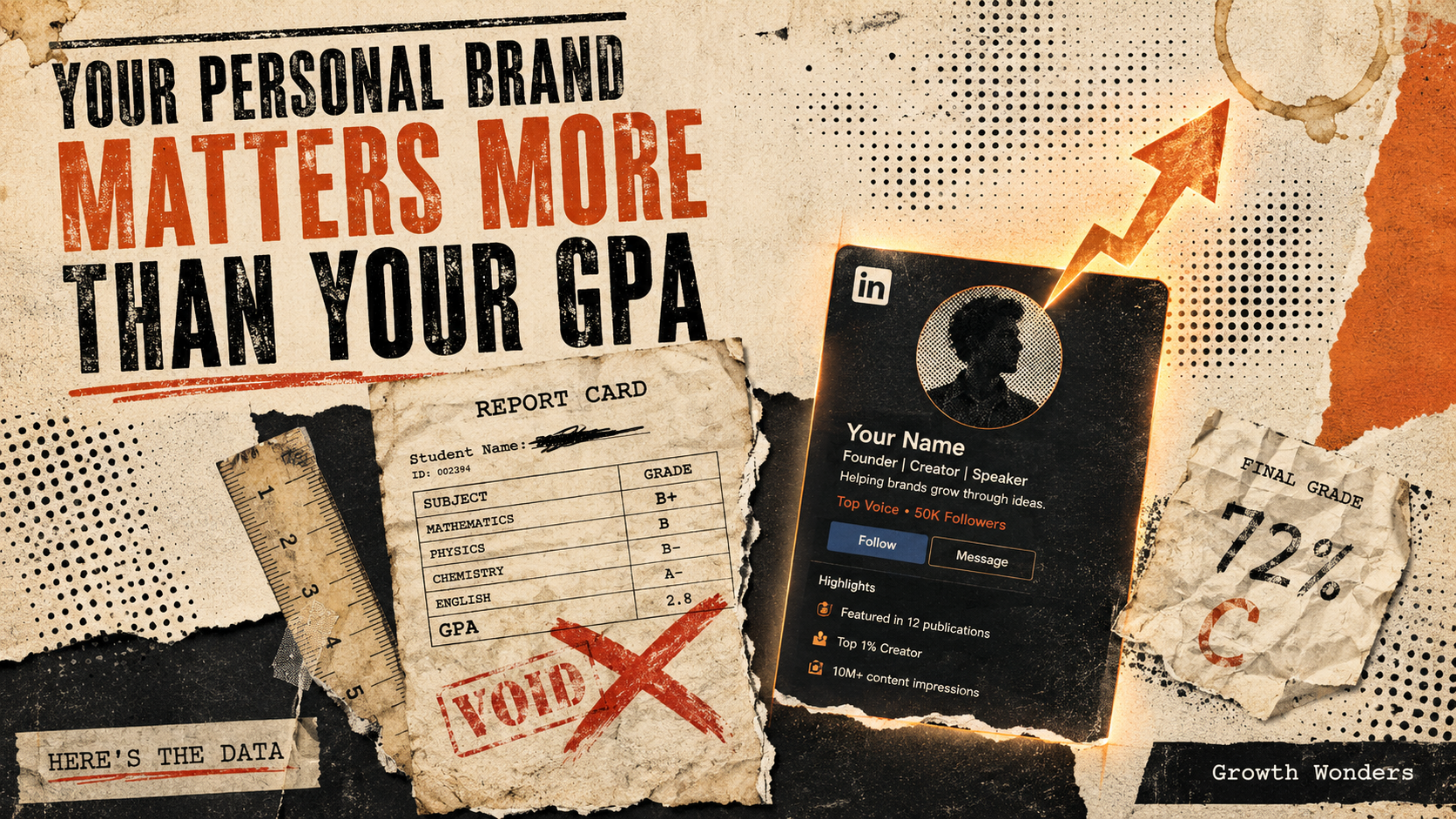
Discover why your GPA is no longer the gatekeeper to career success. Explore the data on skills-first hiring, LinkedIn portfolio strategies, and how to build a high-visibility personal brand.
Move fast and break things is terrible startup advice for bootstrapped startups. Learn how to grow a bootstrapped startup without VC funding sustainably.
Discover why great MVPs die in the first 100 days due to the post-launch hangover. Learn how to build systematic marketing to survive when the hype fades.
Growth Wonders uses strictly necessary cookies to ensure our tools and calculators function properly. We also use analytics cookies to understand how visitors interact with our platform, allowing us to improve your experience.
Read our Privacy Policy.