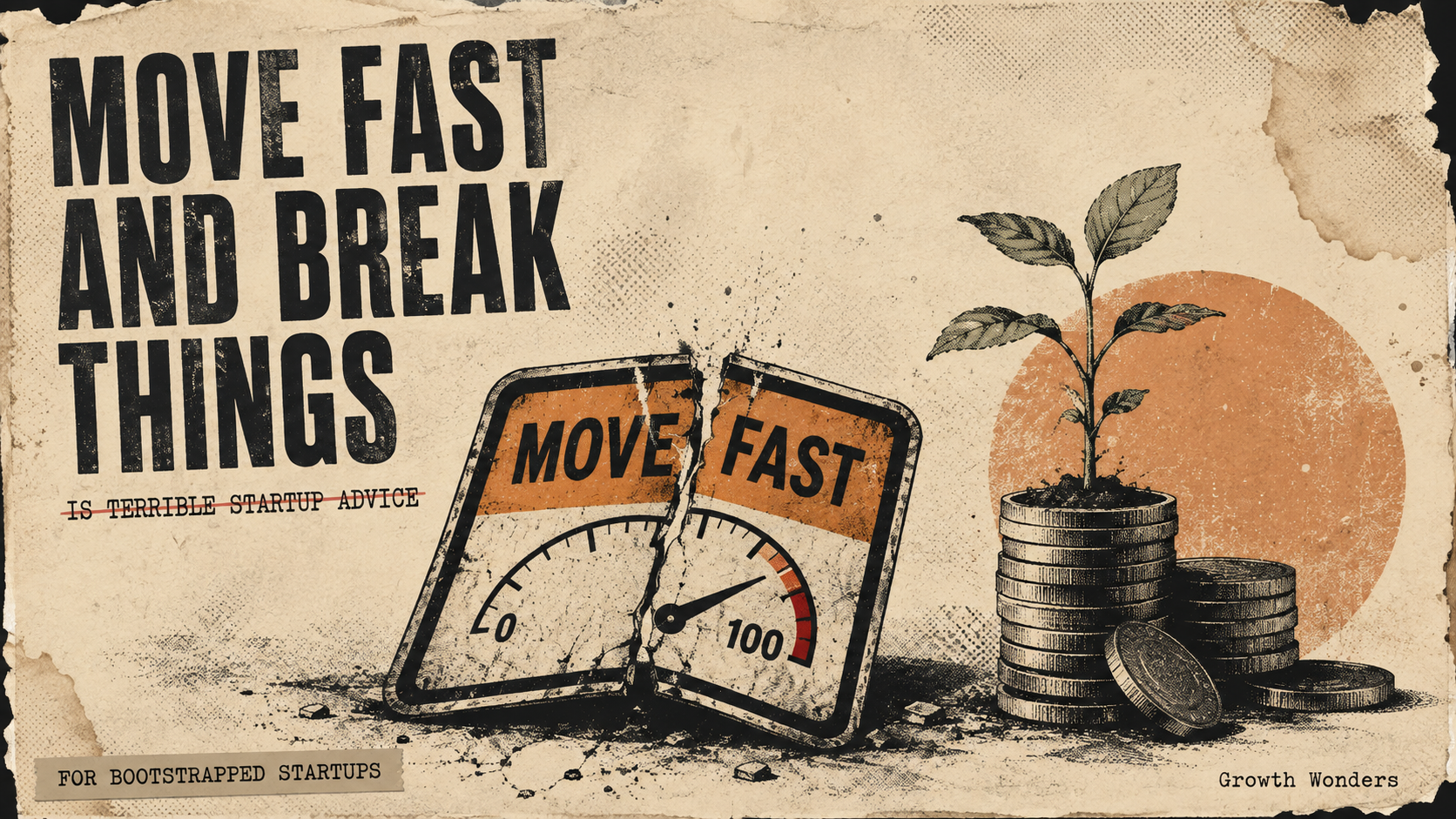
The "move fast and break things" philosophy is highly detrimental for bootstrapped startups because it relies on massive venture capital to absorb the financial costs of mistakes and customer churn. Bootstrapped startups must instead prioritize sustainable growth, positive cash flow, and meticulous product-market fit to survive. Unlike VC-funded competitors, founders of bootstrapped startups cannot afford to alienate early customers or rebuild broken infrastructure without risking total bankruptcy.
Why "Move Fast and Break Things" is Terrible Advice for Bootstrapped Startups
I remember sitting in a coffee shop a few years ago, listening to a young founder pitch his vision. He was building a software product and proudly told me he was following the classic Silicon Valley startup advice: he was going to move fast and break things. I asked him how much funding he had raised. He smiled and said he was entirely self-funded. I took a sip of my coffee and sighed. I knew right then that his business was in serious trouble.
The phrase "move fast and break things" was popularized by Mark Zuckerberg in the early days of Facebook. It has since become the golden rule of startup advice. But here is the truth that nobody tells you: this is terrible startup advice for bootstrapped startups. It is a philosophy built for companies floating on an ocean of venture capital. If you are running a bootstrapped startup, following this startup advice is the fastest way to bankrupt your company. Bootstrapped startups operate in a completely different reality than funded companies. Bootstrapped startups cannot afford to break things because bootstrapped startups have to pay for the repairs out of their own empty pockets.
Let me explain exactly why this popular startup advice fails bootstrapped startups and how to grow a bootstrapped startup without VC funding.
The Billion-Dollar Echo Chamber of Startup Advice
When you read popular startup advice blogs or listen to entrepreneurial podcasts, you are usually hearing from founders who have raised millions of dollars. Their startup advice is tailored to their specific environment. In the venture capital world, growth is the only metric that matters. Funded startups are encouraged to move fast, acquire users at any cost, and ignore profitability until they reach a massive scale. If they break a few things along the way (like their code, their customer trust, or their unit economics), the venture capitalists simply write another check to fix it.
Bootstrapped startups do not have this luxury. For bootstrapped startups, the margin of error is basically zero. If bootstrapped startups move fast and break their core product, they lose their paying customers. If bootstrapped startups lose their paying customers, they lose their cash flow. And if bootstrapped startups lose their cash flow, the business dies. It is a simple, brutal mathematical equation. Therefore, taking startup advice designed for billionaires and applying it to bootstrapped startups is a recipe for disaster. Bootstrapped startups need a fundamentally different playbook.
Bootstrapped Startups Cannot Afford to Break Trust
Let us talk about customer trust. When a funded company releases a buggy product, they can afford to lose a percentage of their users. They have the marketing budget to simply buy more users through paid advertising. Their customer acquisition cost (CAC) is subsidized by investors.
For bootstrapped startups, early customers are the lifeblood of the business. Bootstrapped startups rely heavily on word-of-mouth marketing, organic search, and personal relationships to acquire users. If bootstrapped startups move fast and release a broken product, they destroy that trust. An angry customer will not recommend your product to their friends. In fact, they will actively tell people to avoid your bootstrapped startup. Bootstrapped startups simply do not have the marketing budget to replace angry customers. Every single user matters for bootstrapped startups. Breaking things means breaking trust, and bootstrapped startups cannot survive without trust.
Free Tool
Stop guessing. Start growing. Find out exactly what is holding your website back from ranking on Google in seconds.
I always tell founders of bootstrapped startups to focus on quality over speed. It is better for bootstrapped startups to release one polished feature a month than four buggy features a week. Quality is the ultimate growth hack for bootstrapped startups.
The Mathematics of Mistakes for Bootstrapped Startups
As someone who looks at financial statements all day, I want to break down the mathematics of why this startup advice fails bootstrapped startups.
Imagine a venture-backed company with $10 million in the bank. Their burn rate (the amount of money they lose each month) might be $500,000. They have 20 months of runway. If they move fast and make a huge mistake that costs them $1 million to fix, they still have 18 months of runway left. The mistake hurts, but it is not fatal.
Now imagine a bootstrapped startup. The founder has $50,000 in personal savings. The monthly expenses are $5,000, and the monthly revenue is $3,000. The bootstrapped startup is burning $2,000 a month. They have 25 months of runway. But if they move fast and make a mistake that costs $10,000 to fix, they have instantly wiped out five months of runway. A few more mistakes, and the bootstrapped startup is out of cash.
Bootstrapped startups cannot absorb the financial impact of breaking things. Every dollar spent fixing a broken feature is a dollar that bootstrapped startups cannot spend on marketing, sales, or customer support. For bootstrapped startups, cash flow is oxygen. Moving fast and breaking things is essentially setting your oxygen supply on fire. This is why careful planning is far superior startup advice for bootstrapped startups.
Sustainable Growth vs Hypergrowth
The obsession with moving fast comes from the desire for hypergrowth. Venture capitalists want their portfolio companies to grow 300 percent a year so they can secure a massive exit. But bootstrapped startups do not need to achieve hypergrowth to be successful.
How to grow a bootstrapped startup without VC funding requires a shift in mindset. Bootstrapped startups should aim for sustainable, compounding growth. Growing 20 percent year-over-year might sound boring to a venture capitalist, but for bootstrapped startups, it is a path to lasting wealth and independence. Sustainable growth allows bootstrapped startups to maintain positive profit margins, keep full equity, and build a business that can survive economic downturns.
Bootstrapped startups must focus on the fundamentals: building a product people want, charging a fair price, and keeping expenses low. If bootstrapped startups focus on these fundamentals, they will naturally grow at a healthy pace. They do not need to artificially inflate their speed by breaking things. Sustainable growth is the best startup advice for bootstrapped startups.
Advance Your Career
Get certified by industry experts. Join our comprehensive 360° training program and land your dream job with practical, hands-on experience.
Explore Courses
Building for Profitability Instead of the Next Round
Funded startups operate in cycles. They raise a seed round, move fast to hit arbitrary metrics, and then raise a Series A round. Their goal is not profitability; their goal is simply to secure the next round of funding.
Bootstrapped startups operate in a continuous reality. There is no next round of funding coming to save them. Bootstrapped startups must build for profitability from day one. This means bootstrapped startups must carefully evaluate every feature, every marketing campaign, and every hire based on its potential to generate a positive return on investment. Bootstrapped startups cannot afford to build features just to see what happens. They must be strategic.
When bootstrapped startups prioritize profitability, they gain ultimate freedom. Bootstrapped startups do not have to answer to a board of directors. The founders of bootstrapped startups retain 100 percent of the equity. If they want to take a month off, they can. If they want to pivot the business model, they can. This freedom is the true reward of running bootstrapped startups, but it requires ignoring the "move fast and break things" startup advice entirely.
When Should Bootstrapped Startups Actually Move Fast?
I want to be clear. I am not saying that bootstrapped startups should move like turtles. Speed is important in business. But bootstrapped startups must apply speed to the right areas.
Bootstrapped startups should move fast when talking to customers. If a customer has a problem, bootstrapped startups should fix it immediately. Bootstrapped startups should move fast when learning from the market. Bootstrapped startups should move fast to cut unnecessary expenses.
However, bootstrapped startups should never move fast when writing core code, setting up security protocols, or designing their pricing architecture. These are the foundations of the business. If bootstrapped startups break these foundations, the entire house will collapse. Bootstrapped startups must move carefully and deliberately when building the core engine of their company.
The Bootstrapped Founder's Playbook: Move Smart and Build Things
If "move fast and break things" is terrible startup advice for bootstrapped startups, what should the new mantra be? I propose: "Move smart and build things."
Bootstrapped startups need to be intelligent with their limited resources. Bootstrapped startups must build solid, reliable products that solve real problems. Here is a brief playbook for bootstrapped startups to follow instead of the traditional Silicon Valley startup advice:
Custom Solutions
Build Powerful Digital Experiences
Scale your business with high-performance, IOS and Mobile Apps.
Start Your Project
First, bootstrapped startups must deeply understand their target audience. Do not guess what they want. Talk to them. Validate the idea before writing a single line of code.
Second, bootstrapped startups should build a Minimum Lovable Product (MLP) instead of a Minimum Viable Product (MVP). The product does not need every feature, but the features it does have must work perfectly. Bootstrapped startups cannot afford to release a buggy MVP.
Third, bootstrapped startups must charge money from day one. Do not give the product away for free in hopes of monetizing later. Bootstrapped startups need cash flow immediately to survive. Charging money also validates that you are solving a problem worth paying for.
Fourth, bootstrapped startups must automate everything they can. Since bootstrapped startups usually have small teams, they must rely on software to handle repetitive tasks. This keeps overhead low and margins high.
By following this startup advice, bootstrapped startups can build incredibly profitable, durable businesses without ever needing to beg venture capitalists for money.
The Reality of Running Bootstrapped Startups
Running bootstrapped startups is arguably harder than running funded companies. Bootstrapped startups do not get the flashy tech press coverage. Founders of bootstrapped startups do not get to throw lavish launch parties. It is a quiet, difficult grind.
But the payoff for successful bootstrapped startups is immense. You own your time, you own your company, and you build real business acumen. You learn how to respect cash flow, how to value customers, and how to build a product that stands on its own merits.
So, the next time you hear a billionaire tell you to "move fast and break things," just smile and keep walking. That startup advice is not for you. You are building bootstrapped startups, and bootstrapped startups require a smarter, stronger foundation. Do not break things. Build things that last.