The primary reason great MVPs die in the first 100 days is a phenomenon known as the post-launch hangover. This occurs when the initial burst of traffic from launch events naturally decays, and founders realize they have not implemented any systematic marketing channels to sustain customer acquisition. To survive the post-launch hangover, startups must immediately shift their focus from product engineering to building repeatable, measurable sales pipelines before their initial momentum completely flatlines.
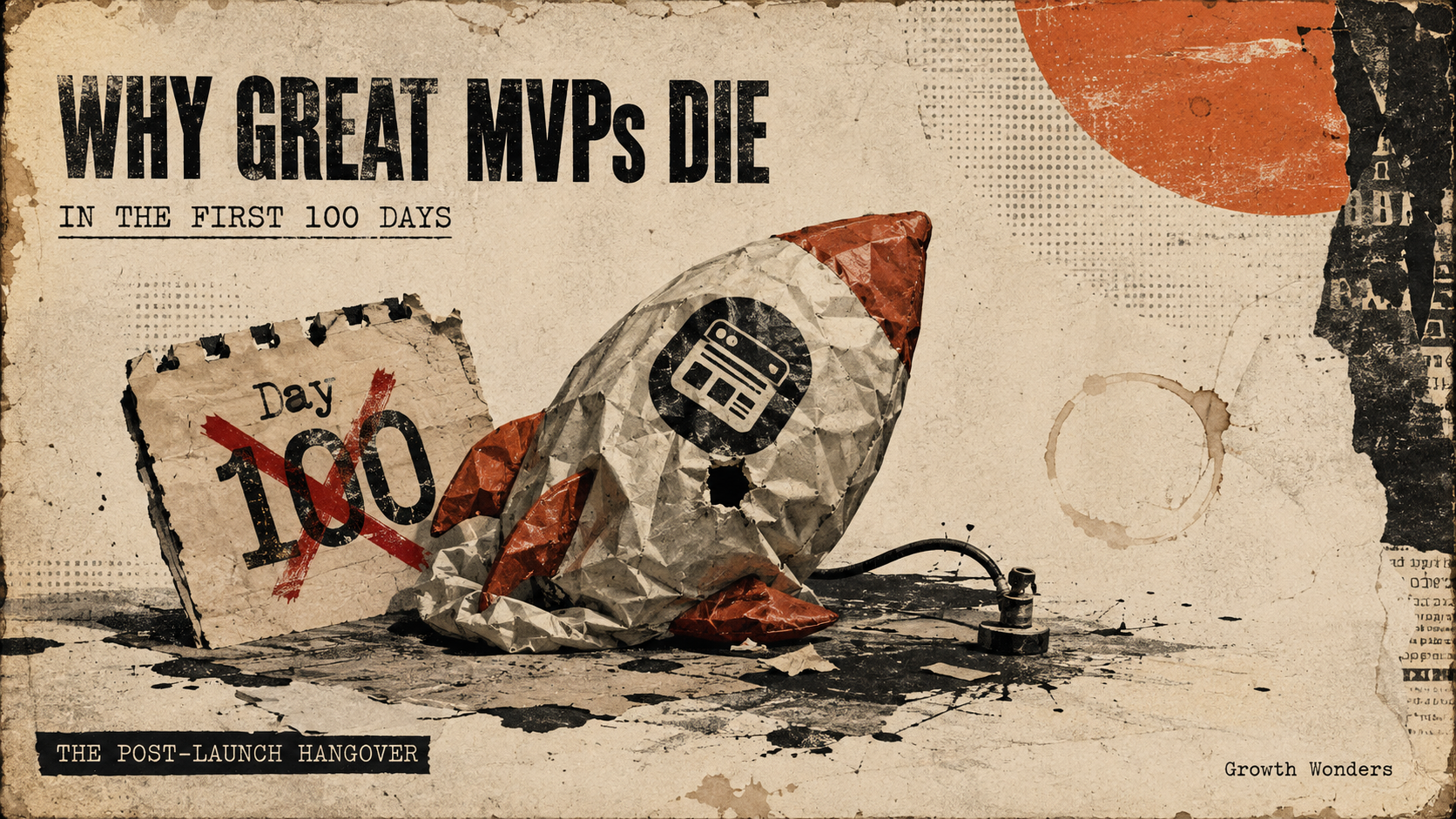
Why Great MVPs Die in the First 100 Days: Surviving the Post-Launch Hangover
I have seen the exact same tragedy play out hundreds of times. A founder spends six months building a brilliant software product. They launch it on a Tuesday morning. For the first 48 hours, they feel like the smartest person in the room. They are featured on popular tech forums, their social media notifications are buzzing, and they are refreshing their analytics dashboard every twelve seconds just to watch the active user count climb.
Then comes the following Thursday.
The traffic graph, which previously looked like a glorious mountain peak, suddenly looks like a steep cliff. By day 14, the daily active users chart resembles a flatline on a hospital monitor. By day 60, the founder is sitting at their desk, staring at a screen, wondering where everyone went. By day 100, the servers are quietly shut down.
This is what I call the post-launch hangover. It is the exact moment when traction completely stalls because the initial hype fades and systematic marketing has not yet kicked in. The post-launch hangover is the number one reason why great MVPs die in the first 100 days.
Today, we are going to look closely at the post-launch hangover. I will explain why great MVPs fail when they rely on hope instead of cold, hard mathematics. I will also show you how to build the systematic marketing required to survive your first 100 days.
The Illusion of the Launch Day
The biggest lie in the software industry is that a good product sells itself. This is simply not true. A good product retains customers, but it absolutely does not acquire them on its own.
Free Tool
Get Your Free SEO Audit
Stop guessing. Start growing. Find out exactly what is holding your website back from ranking on Google in seconds.
When you launch a Minimum Viable Product (MVP), you are usually tapping into borrowed audiences. You post on sites like Product Hunt, Reddit, or Hacker News. These platforms give you a temporary megaphone. The traffic you get on launch day is not a reflection of your business model. It is merely a reflection of novelty. People like clicking on new things.
However, novelty has a very short shelf life. Hype is exactly like eating a giant bowl of sugary cereal for breakfast. It feels fantastic for about twenty minutes, and then you crash incredibly hard. Once you fall off the front page of those launch websites, the traffic stops. If you do not have systematic marketing ready to catch the baton, your business drops it. And when you drop the baton, great MVPs die.
(Also, just to be clear, your mother signing up for a premium subscription on day two does not count as product-market fit.)
The Anatomy of the Post-Launch Hangover
Let us look at a timeline. I have analyzed dozens of failed products to understand the exact lifecycle of the post-launch hangover. Here is a breakdown of what happens when great MVPs die in the first 100 days because they lack systematic marketing.
Phase
Days
Founder's Emotion
Primary Traffic Source
Required Action to Survive
The Hype High
1 to 10
Euphoric
Launch platforms, social media spikes, friends.
Do not get comfortable. Start building the sales engine.
The Warning Dip
11 to 30
Confused
Trickle-down traffic from older posts.
Realize the hype is over. Begin systematic marketing immediately.
The Post-Launch Hangover
31 to 60
Panicked
Direct traffic from the few remaining users.
Transition to cold outreach, SEO, or paid ads.
The Pivot or Perish
61 to 100
Defeated
None.
Shut down, or radically alter the customer acquisition strategy.
Source: Independent Market Analysis of Startup Failures (2024)
As the table shows, the post-launch hangover sets in during the second month. This is the critical window. If you do not have systematic marketing fully operational by day 30, you are mathematically guaranteed to enter the "Perish" phase. Great MVPs die because founders spend days 11 through 30 tweaking button colors instead of making sales calls.
Real-World Examples: When Hype Is Not Enough
Let us look at a real-world example of the post-launch hangover in action.
Advance Your Career
Master Digital Marketing
Get certified by industry experts. Join our comprehensive 360° training program and land your dream job with practical, hands-on experience.
In 2011, a photo-sharing application called Color launched. They managed to raise an astonishing $41 million before they even released the product. Their launch was a masterclass in hype. Every tech blog wrote about them. They had millions of eyeballs on their brand on day one.
But Color suffered from a massive post-launch hangover. They had no systematic marketing to sustain the initial curiosity. People downloaded the app, realized their friends were not actively using it, and deleted it. Color assumed the hype would act as a permanent marketing engine. They were wrong. The product completely failed shortly after, proving that even with $41 million in the bank, the post-launch hangover will destroy you if you do not have a sustainable acquisition strategy.
Now, let us look at a positive example. Think about the early days of Dropbox. They had a great MVP, and they got some initial hype on tech forums. But the founders were smart enough to know that the post-launch hangover was coming. To prevent their great MVP from dying, they built systematic marketing directly into the product.
They introduced a brilliant referral program: if you invite a friend, you both get extra storage space. This is the definition of systematic marketing. It is measurable, repeatable, and relies on human incentives rather than temporary hype. Because they built this systematic marketing engine early, they completely bypassed the post-launch hangover and grew into a massive public company.
The Mathematics of Systematic Marketing
As a financial analyst, I prefer to look at business through the lens of numbers. The difference between hype and systematic marketing is purely mathematical.
Hype is a one-time injection of traffic with an unpredictable conversion rate. You cannot put hype into a spreadsheet. You cannot tell your accountant, "I project we will get three viral tweets next month, so our revenue will double."
Systematic marketing is an equation. It looks like this: If I spend $1,000 on search engine optimization, I will get 5,000 visitors over six months. If 2 percent of those visitors convert, I will acquire 100 new users. If each user pays $50, my return is $5,000.
Custom Solutions
Build Powerful Digital Experiences
Scale your business with high-performance, IOS and Mobile Apps.
This is how you survive the post-launch hangover. You must replace the unpredictable spike of launch day with the boring, predictable mathematics of systematic marketing. Great MVPs die because founders refuse to do the boring math. They want the thrill of the launch to last forever.
How to Build Systematic Marketing Before Day 50
If you want to ensure your great MVP survives the first 100 days, you must act quickly. Here is the playbook to beat the post-launch hangover.
First, identify your single most reliable acquisition channel. Do not try to be on every social media platform at once. Pick one channel that you can control. If your product solves a specific business problem, your systematic marketing should probably be cold email outreach. If your product answers a common question, your systematic marketing should be SEO-driven content.
Second, start treating marketing like engineering. You built your great MVP using logic, testing, and iteration. You must apply that exact same rigor to your marketing. Write ten different email templates. Send them to ten different groups. Measure the open rates. Keep the winners and discard the losers. Systematic marketing is simply engineering applied to human psychology.
Third, talk to the people who stayed. Out of the thousands of people who visited your site on launch day, maybe fifty stuck around to actually use the product. Call those fifty people. Ask them why they stayed when everyone else left. Their answers will give you the exact vocabulary you need to fuel your systematic marketing campaigns.
Conclusion: Stop Refreshing and Start Selling
The first 100 days of a startup's life are brutal. The post-launch hangover is a very real, very dangerous phase. But it is entirely survivable.
Great MVPs die because founders get addicted to the easy traffic of launch day. They mistake an audience for a customer base. To survive the post-launch hangover, you must step away from your analytics dashboard. Stop refreshing the page hoping for a miracle spike in traffic. Stop tweaking your logo.
Instead, roll up your sleeves and build a systematic marketing engine. Pick up the phone. Write the long-form articles. Run the small, highly targeted ad campaigns. The companies that survive the post-launch hangover are not the ones with the best code. They are the ones with the discipline to build systematic marketing when the hype finally fades away.
The post-launch hangover is the period immediately following a product launch when initial hype and viral traffic fade away, leaving the startup with a flatlining user base. It usually hits between day 14 and day 30, and it is the main reason great MVPs die in the first 100 days.
A great MVP can have perfect code and a beautiful design, but if nobody knows it exists, it will generate zero revenue. Startups fail not because they cannot build a product, but because they cannot build a systematic marketing engine to distribute that product profitably.
To transition, you must stop relying on one-off events (like a Product Hunt launch or a viral social media post). Instead, you must build repeatable processes with measurable Customer Acquisition Costs (CAC). Examples include setting up an automated cold email sequence, publishing SEO-optimized articles weekly, or launching a structured referral program.
You should plan your systematic marketing strategy before you even write the first line of code for your MVP. By the time launch day arrives, your long-term acquisition channels (like SEO or paid advertising funnels) should already be in motion to catch the momentum and prevent the post-launch hangover entirely.
Written by
Prateek Singh
Digital Marketing Expert & Manager, at Growth Wonders
I’m a Digital Marketing strategist and lead at Growth Wonders, specializing in SEO and high-speed web solutions. I leverage AI-driven content and technical performance to drive measurable brand growth.
Discover why your GPA is no longer the gatekeeper to career success. Explore the data on skills-first hiring, LinkedIn portfolio strategies, and how to build a high-visibility personal brand.
Move fast and break things is terrible startup advice for bootstrapped startups. Learn how to grow a bootstrapped startup without VC funding sustainably.
Growth Wonders uses strictly necessary cookies to ensure our tools and calculators function properly. We also use analytics cookies to understand how visitors interact with our platform, allowing us to improve your experience.
Read our Privacy Policy.